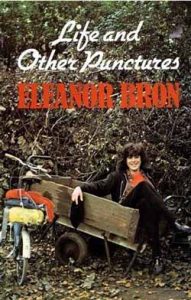
Life And Other Punctures, Eleanor Bron (1978)
Sixties siren makes merry on a Moulton
Andre Deutsch 0233970088 111pp Quarto
For cultured men of a certain age – born during the 1930s, most probably – Eleanor Bron was the sex symbol of the satire boom. In1959 she was first woman to appear in Cambridge University Footlights, and went on to become the female face of television’s comedy revolution. She performed at Peter Cook’s Establishment Club, was a television sidekick of David Frost and appeared in the Beatle’s Help. Now in her mid-70s, her body of work has been consistent and is ongoing – even if she has not scaled the heights that some thought likely when the small screen made her a household name.
On the basis of this modest tome, it is a shame that she has not written more. Recounting cycle trips on a Moulton, this volume takes Bron to northern France and Holland via her childhood, a peripatetic acting career and loves various. Hers are not athletic excursions, but gentle solo perambulations punctuated by comic twilight searches for hotels.
She has a fine amusing, turn of phrase. Considering her appearance with her jeans tucked into her long black woollen socks, for example, she supposes that she looks like: “like a trainee lady stormtrooper who had yet to earn her jackboots”. And a former beau (who she met in the Playboy Club) “looked like a cross between DH Lawrence and Abraham Lincoln”.
Here she considers the relative merits of cycling and walking: “walking, though simple, was never so silent speedy stealthy sly – it is brain over brute strength, running on wheels, whizzing round corners alarming pedestrians with a sudden bell, sneaking in and out of dead-locked traffic, with a system of judicious leap-off-and-push, cutting through one-way systems like flute in the night; yet still itself remaining engagingly vulnerable, at the mercy of any motor, squeezing into rough gutters, startled by abruptly opened doors, drenched by any van passing a puddle. These and other hazards keep complacency at bay”.
The France she visits is one that she knows from its literature – so Hugo, Montaigne and Baudelaire provide her guide book. Unsurprisingly she is also informed by theatre. When the despicable hotelier Monsieur Ix makes a play for her bedroom, she is not surprised. He had already revealed to her a suspect character by his enthusiasm for Jean Anoiuh, the playwright who some accused of harbouring sympathies for France’s Vichy regime.
This is not a book that will prove in the least bit useful if you are planning to follow in Bron’s wheel tracks. If, however, you are wondering how experience so slight that is scarce seems worth recording can be turned into a diverting read, there can be few better places to start.
TD Dec 12