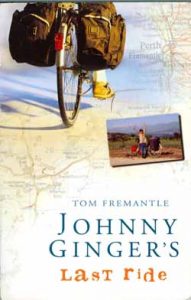
Johnny Ginger’s Last Ride, Tom Fremantle (2000)
A surprisingly enjoyable and insightful account of a twenty-something journalist’s solo ride from the UK to Australia in 1996
Pan Books 0 333 37692 6 paperback 464pp £7.99
I feared that joining Tom Fremantle on his 12,000 mile quest would be a chore. The privately-educated, Peer’s son, calls a 1,300 acre estate in Buckinghamshire home. He even counts the former Tory leader Iain Duncan Smith as his brother in law.
Having failed to pursue the kind of career of which he believed his parents may have approved, the author decided, in his late 20s, to recreate the journey made by one of his great, great, great uncle, Captain Charles Fremantle. In 1829 the eminent forbearer sailed to western Australia in the service of the Royal Navy. There, a port was named after him, and a town nearby was named Swanbourne, after the Buckinghamshire village that the Fremantle’s have called home for the past two centuries.
It might sound like a send up of a Richard Curtis film pitch, but happily Fremantle’s decency and likability spring from the page from his first turn of the wheel. Of course, he bumps into plenty of interesting characters en route – some of whom show him the extraordinary kindness at which travellers are won’t to marvel. He has the same problems with borders and visas that bedevil round-the-world cyclists. And the daily grind of adverse weather, finding food and shelter and keeping his bike on the road give him periodic headaches.
Here he is staying at the Golden Temple in Amritsar (India).
“The food was indigestible, the water brackish and the floor uncomfortable, but none of this mattered. It was the spirit of the occasion that left such a wonderful aftertaste. Where else in the world could you sit with hundreds of others, eating and drinking free of charge, a mass of different creeds and colours all high on each other’s company? There are few occasions in life when one feels intensely proud to be a human being. For me, dining at the Golden Temple canteen was one of them.”
It is this open mindedness and humility that make travelling at his side fun.
Although his style is low-key, he is also a significantly better writing that many who recount their globetrotting. He does not dwell on famous relative’s quest that he is recreating, but it does provide a periodic change of tone in the narrative. And, unlike so many of the genre, journey’s end does not find him jaded. Indeed, he even manages to find a kind of resolution that rewards readers for seeing him through to the last pedal stroke.
PS June 09