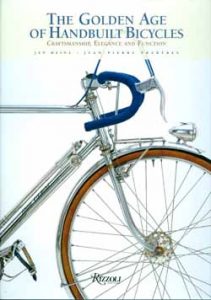
The Golden Age Of Handbuilt Bicycles, Jan Heine and Jean-Pierre Praderes (2009)
A sumptuous photographic history of French touring bicycles manufactured between 1930 and 1950 that recounts a little-known period of cycling history and celebrates two-wheeled engineering at its most delightful
Rizzoli International Publications
978 0 8478 3094 7 Quarto 168pp $50
Anyone steeped in British cycling might initially bristle as they consider the fifty machines pictured herein. They are all French! Where are the Hetchins, Bates, Mercians and Flying Scots? Surely our fancy lugwork, ingenious designs and brazed-on fittings are the equal of anything they produce across the Chanel?
But the ‘golden age’ in question here is a rather more specific moment in time. In the years following the statutory enforcement of a 40 hour week and two weeks paid holiday in France, there was a rush of enthusiasm for cycle touring. A plethora of initiatives followed – from annual technical trials for touring bicycles, to ‘competitive’ randonneaurs and other events. At the same time, a small number of ‘constructors’ started to offer complete bicycles that aimed to be as light as possible, while including wide-ratio gears, front and rear racks and integral lighting.
The result was some stunning pieces of design, sold as complete bicycles – unlike the British marques, where it was more common to buy a frame and then build it up yourself. Rene Herse’s Coucours de Machines of 1947, for example, had front and rear derailleurs, racks to carry 4kg of luggage, dynamo and lights and yet weighed just 7kg (14.4lbs). It is also a thing of exquisite beauty. In the same year, Alex Singer was producing a bike with custom brakes, wingnuts, fork crown and mudguards.
These machines are the result of a fetishistic attention to detail that makes today’s specialist custom builders look like garden-shed tinkerers.
Sprinkled within the text – which is more in the way of fat captions than a comprehensive history – there are any number of charming tales. The annual race for porteurs (bicycle-riding deliverers of huge bundles of newspapers) that took place in Paris for many years, the involvement of aluminium manufacturers in the promotion of lightweight bicycles, and, the use of a 1946 Rene Herse tandem Jan Heine himself in the 2003 Paris-Brest-Paris, stand out. Heine, incidentally, is the editor of the excellent Bicycle Quarterly.
There is much in these designs that became the givens of cyclo-touring bikes – brazed lugs to attach anything to the frame, randonneur handlebars and wide-ratio gears. But the culture that spawned them appears to have almost entirely evaporated in its native country, with the arrival of inexpensive motorised transport.
It might have been forgotten entirely had not a handful of American enthusiasts started to discover and collect bicycles of this era from the 1970s onwards. Their cultish obsession means that original French machines are much sought after and difficult to find, it is now possible to buy a Rene Herse bicycle manufactured in Oregon, and, this lavish pictorial journey back in time is available to the rest of us. It is a trip that anyone with an interest in touring bicycles will find a stimulating pleasure.
PS April 09
Incidentally, I bought a new copy of this book through Amazon for £16